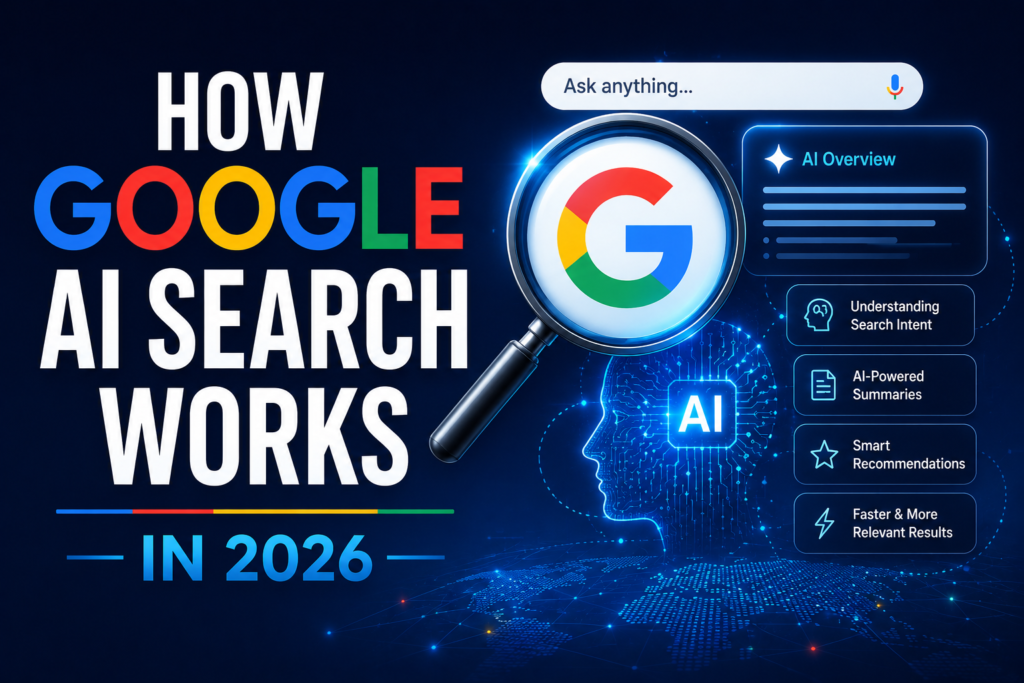
The way people search online is changing rapidly in 2026. Traditional search engines are evolving into intelligent AI-powered systems that understand conversations, predict user intent, and generate direct answers instantly.
Google AI Search is transforming the future of online discovery by combining artificial intelligence, machine learning, natural language processing, and generative AI technologies to deliver smarter and more personalized search experiences.
Instead of simply showing a list of blue links, Google AI Search now provides:
- AI-generated summaries
- Conversational answers
- Personalized recommendations
- Context-aware search results
- Predictive search experiences
This shift is revolutionizing SEO, content marketing, and digital visibility for businesses worldwide.
What is Google AI Search?
Google AI Search refers to Google’s AI-powered search experience that uses advanced artificial intelligence models to understand user intent and generate intelligent search responses.
Modern Google Search combines:
- Generative AI
- Machine learning
- Natural language understanding
- Semantic search
- Knowledge graphs
- Predictive analytics
The goal is to provide users with faster, more accurate, and highly relevant answers.
In 2026, Google AI Search focuses more on understanding meaning and context rather than just matching keywords.
How Google AI Search Works
Google AI Search operates through several advanced AI technologies working together.
1. Natural Language Understanding (NLU)
Google AI can now understand conversational and human-like queries.
Instead of relying only on exact keywords, AI search analyzes:
- Context
- Search intent
- User behavior
- Semantic meaning
- Conversational phrasing
For example:
Old Search:
“best SEO agency India”
Modern AI Search:
“Which SEO company is best for AI search optimization in India?”
Google AI understands both queries and delivers contextually relevant results.
This makes search more natural and user-friendly.
2. Generative AI Creates Search Summaries
One of the biggest changes in Google AI Search is AI-generated summaries.
Instead of forcing users to visit multiple websites, Google AI can generate direct answers by analyzing content from various sources across the internet.
These AI summaries often appear:
- Above traditional search results
- In conversational formats
- With follow-up question suggestions
This is changing how users interact with search engines completely.
Businesses now need content optimized not only for rankings but also for AI-generated search visibility.
3. Semantic Search Understanding
Google AI Search uses semantic search to understand:
- Relationships between words
- Search intent
- Topic relevance
- Contextual meaning
This means modern SEO is no longer about stuffing exact-match keywords.
Google now prioritizes:
- Topic authority
- High-quality content
- User experience
- Contextual relevance
- Trustworthiness
Content that genuinely answers user questions performs better in AI search environments.
4. AI Search Uses Machine Learning
Machine learning allows Google AI Search to continuously improve search accuracy.
Google analyzes:
- User interactions
- Click behavior
- Search patterns
- Engagement signals
- Search satisfaction
AI systems learn from billions of searches daily to improve future results.
This helps deliver:
- Personalized experiences
- Faster search results
- Better recommendations
- More accurate answers
5. AI Search is Personalized
In 2026, search results are increasingly personalized.
Google AI considers:
- User location
- Search history
- Device type
- Preferences
- Previous interactions
- Real-time behavior
This means two users searching the same query may see different AI-generated responses.
Personalization is becoming a major part of modern search experiences.
6. Conversational Search is Growing
Users now interact with search engines conversationally.
Google AI supports:
- Follow-up questions
- Multi-step search interactions
- Conversational browsing
- Context retention
This makes search more similar to chatting with an AI assistant than using a traditional search engine.
Voice search and AI assistants are accelerating this trend rapidly.
7. AI Search Uses Knowledge Graphs
Google’s Knowledge Graph helps AI understand relationships between:
- People
- Companies
- Topics
- Products
- Places
- Concepts
This allows Google AI Search to provide:
- Rich snippets
- Entity-based answers
- Related topics
- Smart recommendations
Knowledge Graph technology helps AI connect information intelligently.
Why Google AI Search Matters for Businesses
Google AI Search is changing how businesses gain online visibility.
Traditional SEO alone is no longer enough.
Businesses now need to optimize for:
- AI-generated answers
- Conversational search
- Semantic relevance
- Answer engines
- Generative AI platforms
Companies that fail to adapt risk losing traffic, leads, and search visibility.
How AI Search is Changing SEO
AI-powered search engines are transforming SEO strategies completely.
Modern SEO now focuses on:
- User intent
- Topic clusters
- E-E-A-T
- Conversational content
- Structured data
- AI-friendly formatting
- Semantic optimization
Businesses need content that:
- Answers questions clearly
- Provides value
- Demonstrates expertise
- Is easy for AI to understand
What is an AI Search Engine?
An AI Search Engine is a search platform powered by artificial intelligence that delivers intelligent, conversational, and context-aware results.
Unlike traditional search engines, AI search engines:
- Understand natural language
- Generate summaries
- Learn user behavior
- Personalize results
- Support conversational interactions
Popular AI search platforms include:
- Google AI Search
- OpenAI ChatGPT
- Perplexity AI
- Microsoft Copilot
- Anthropic Claude
AI search engines are shaping the future of digital discovery.
Best Strategies to Rank in Google AI Search
Create High-Quality Content
Detailed, authoritative content performs better.
Optimize for Search Intent
Understand what users truly want.
Use Conversational Language
Natural language improves AI understanding.
Add Structured Data
Schema markup helps AI interpret content.
Build Topical Authority
Cover topics comprehensively.
Focus on E-E-A-T
Experience, expertise, authority, and trustworthiness are critical.
Improve User Experience
Fast-loading, mobile-friendly websites rank better.
Optimize for AI Summaries
Provide concise, direct answers within content.
Google AI Search vs Traditional Search
| Traditional Search | Google AI Search |
|---|---|
| Keyword-focused | Intent-focused |
| Blue links | AI summaries |
| Static results | Conversational responses |
| Manual browsing | Direct answers |
| Exact-match keywords | Semantic understanding |
The future of search is becoming more intelligent and interactive.
The Future of AI Search Engines
AI search engines will continue evolving rapidly.
Future trends include:
- Real-time AI assistants
- Hyper-personalized search
- Predictive search
- Voice-first experiences
- AI shopping assistants
- AI-generated recommendations
- Visual AI search
Businesses that adapt early to AI search optimization will gain major competitive advantages.
Conclusion
Google AI Search is transforming how users discover information online in 2026.
Search is becoming:
- Smarter
- Conversational
- Personalized
- AI-driven
- Context-aware
Traditional SEO strategies alone are no longer enough.
Businesses now need AI search optimization strategies to remain visible in:
- Google AI summaries
- Conversational search
- Voice search
- AI-generated answers
Companies investing in AI SEO, semantic optimization, and high-quality content today will dominate the future of digital visibility.
For AI SEO, website optimization, and digital marketing solutions, visit Ausinch
Leave a Comment