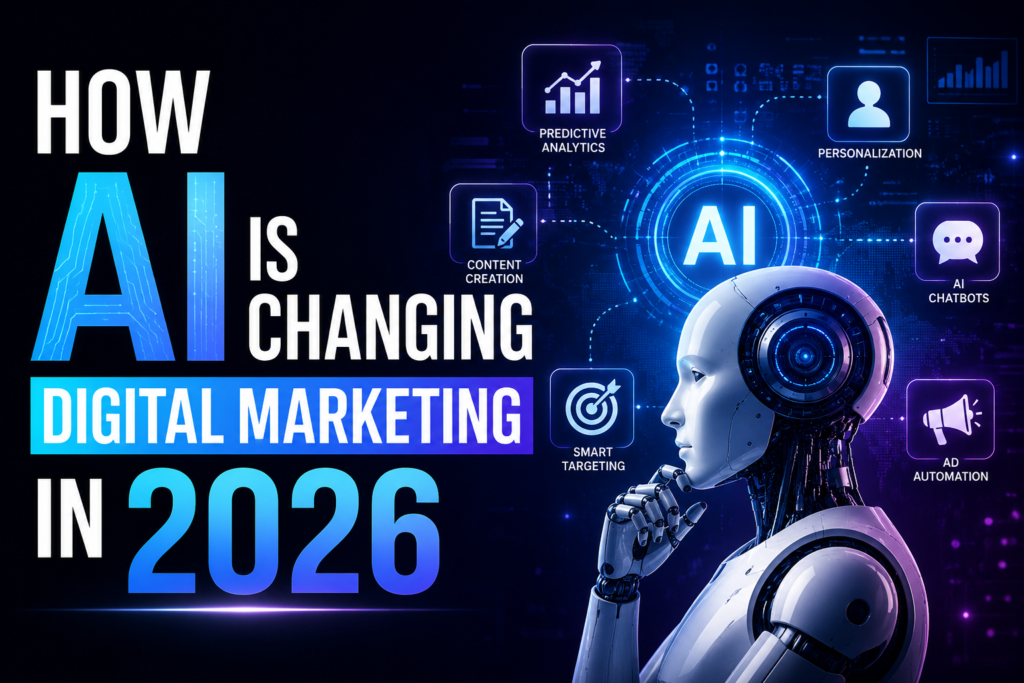
Artificial Intelligence is no longer just a trend in digital marketing — it has become the engine driving modern marketing strategies in 2026. From AI-powered content creation to predictive analytics and hyper-personalized customer experiences, businesses are using AI to automate workflows, improve engagement, and generate higher ROI faster than ever before.
For brands looking to stay competitive online, AI digital marketing is transforming how businesses attract, convert, and retain customers. Companies that adopt AI-driven strategies are seeing significant improvements in campaign performance, audience targeting, SEO visibility, and customer experience. According to recent industry reports, AI is now reshaping search behavior, content optimization, advertising automation, and real-time personalization across all digital platforms.
What is AI Digital Marketing?
AI digital marketing refers to the use of artificial intelligence technologies such as machine learning, predictive analytics, automation tools, and generative AI to improve marketing performance and customer engagement.
Instead of relying only on manual marketing strategies, businesses now use AI to:
- Analyze customer behavior
- Predict buying intent
- Automate ad campaigns
- Generate SEO content
- Personalize customer journeys
- Improve conversion rates
- Optimize social media performance
- Enhance email marketing automation
In 2026, AI marketing tools are becoming smarter, faster, and more accurate, allowing marketers to make data-driven decisions in real time.
Top AI Marketing Trends in 2026
1. AI-Powered Content Creation is Dominating
Generative AI tools are revolutionizing content marketing. Businesses are now using AI to create:
- Blog articles
- Social media captions
- Product descriptions
- Ad copies
- Video scripts
- Email campaigns
- Landing page content
AI significantly reduces content production time while helping marketers scale campaigns efficiently. However, the winning strategy in 2026 is not AI alone — it is the combination of AI speed and human creativity.
Businesses using AI-assisted content strategies can publish high-quality, SEO-optimized content consistently while maintaining brand voice and audience relevance.
2. Hyper-Personalization is the New Standard
Modern consumers expect personalized experiences across every digital touchpoint. AI allows brands to analyze user behavior, preferences, browsing history, and purchase intent to deliver customized experiences in real time.
AI personalization now powers:
- Personalized website content
- Dynamic email campaigns
- Smart product recommendations
- AI chatbots
- Predictive offers
- Personalized ads
Brands are moving from mass marketing to “segment-of-one” marketing, where every user receives a tailored experience based on real-time data.
This level of personalization improves customer engagement, retention, and conversions.
3. AI SEO and Generative Search Optimization (GEO)
Traditional SEO is rapidly evolving in 2026. Search engines now use AI-generated summaries, conversational search results, and answer engines that prioritize authoritative and structured content.
This shift has introduced new strategies such as:
- AI SEO
- Generative Engine Optimization (GEO)
- Answer Engine Optimization (AEO)
Businesses must now optimize content not only for Google rankings but also for AI-generated search experiences.
Key AI SEO practices in 2026 include:
- Conversational content optimization
- Structured data and schema markup
- E-E-A-T focused content
- Semantic keyword targeting
- Long-form authoritative content
- Multi-platform visibility
Brands that fail to adapt to AI-driven search behavior risk losing organic visibility.
4. Predictive Analytics is Improving Decision Making
AI is helping marketers predict customer behavior before users even make purchasing decisions. Predictive analytics tools analyze massive datasets to identify patterns and forecast outcomes.
Businesses use predictive AI for:
- Lead scoring
- Customer churn prediction
- Sales forecasting
- Campaign optimization
- Audience targeting
- Customer lifetime value analysis
Instead of reactive marketing, companies are now using predictive marketing strategies that improve ROI and reduce wasted ad spend.
5. AI-Powered Advertising and Automation
AI-driven advertising platforms are automating campaign management across Google Ads, Meta Ads, LinkedIn, and other digital channels.
AI can now:
- Optimize bids automatically
- Test ad creatives
- Identify high-performing audiences
- Allocate budgets dynamically
- Improve conversion tracking
- Generate multiple ad variations instantly
Marketers in 2026 are focusing more on strategy while AI handles repetitive execution and optimization tasks.
This allows businesses to launch smarter campaigns faster than ever before.
6. AI Chatbots and Conversational Marketing
AI chatbots have evolved into intelligent virtual assistants capable of handling customer interactions 24/7.
Modern AI chatbots can:
- Answer customer queries instantly
- Qualify leads
- Schedule appointments
- Recommend products
- Handle support requests
- Improve customer engagement
Conversational AI is helping businesses increase customer satisfaction while reducing operational costs.
7. Video Marketing + AI is Exploding
Short-form video content continues to dominate social media marketing in 2026. AI tools are helping brands create, edit, and repurpose video content quickly for platforms like:
- Instagram Reels
- YouTube Shorts
- TikTok
- LinkedIn Video
AI-powered tools now assist with:
- Auto-captioning
- Video editing
- Voice generation
- AI avatars
- Script writing
- Content repurposing
Video marketing combined with AI automation is becoming one of the highest-performing digital marketing strategies.
Benefits of AI in Digital Marketing
Businesses adopting AI marketing strategies are experiencing major benefits, including:
Improved Efficiency
AI automates repetitive marketing tasks, saving time and increasing productivity.
Better Customer Insights
AI analyzes customer behavior patterns more accurately than traditional analytics tools.
Higher Conversion Rates
Personalized experiences and predictive targeting improve lead conversions.
Smarter Decision Making
AI-driven analytics provide real-time insights for better marketing decisions.
Cost Reduction
Automation reduces manual workload and optimizes advertising spend.
Enhanced Customer Experience
AI improves customer interactions with faster responses and personalized communication.
Challenges of AI Marketing in 2026
While AI offers significant advantages, businesses also face challenges such as:
- Data privacy concerns
- AI-generated content quality control
- Over-automation risks
- Ethical AI usage
- Ad fraud and fake traffic
- Dependence on AI platforms
Experts warn that businesses should combine AI automation with human oversight to maintain trust, authenticity, and strategic creativity.
The Future of AI Digital Marketing
The future of digital marketing is becoming increasingly AI-driven. In the coming years, AI will continue transforming:
- Search engines
- Content marketing
- Customer engagement
- Advertising automation
- Voice search
- AI assistants
- Predictive commerce
Brands that embrace AI marketing technologies early will gain a major competitive advantage in visibility, personalization, and customer acquisition.
However, successful marketing in 2026 is not about replacing humans with AI — it is about combining AI automation with human creativity, storytelling, and strategy.
Conclusion
AI is redefining digital marketing in 2026 by making campaigns smarter, faster, and more personalized. From AI SEO and predictive analytics to content automation and conversational marketing, artificial intelligence is helping businesses achieve better results with greater efficiency.
Companies that adapt to AI marketing trends now will be better positioned to dominate search rankings, improve customer experiences, and drive sustainable business growth in the evolving digital landscape.
For businesses looking to scale online, investing in AI digital marketing is no longer optional — it is essential.
Leave a Comment